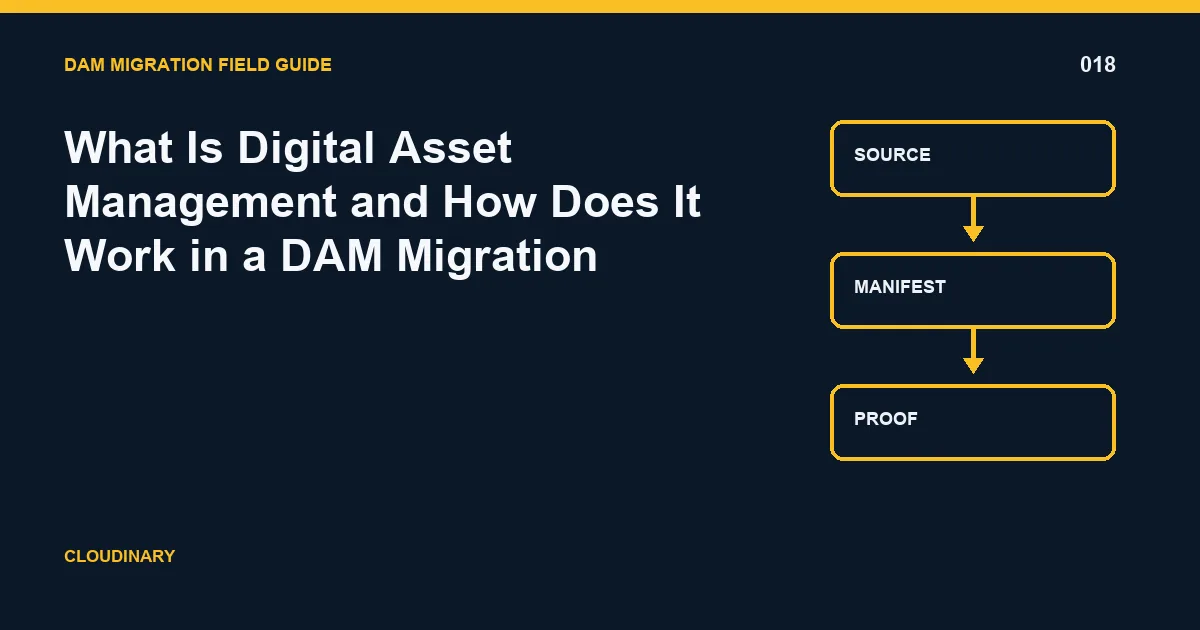
The safest way to handle what is digital asset management and how does it work is to make the work restartable, traceable, and testable before production cutover. The accountable owner should produce documented implementation and validation runbook and accept the result only when a representative migration pack passes binary, metadata, access, and delivery checks.
This guide treats source assets, metadata, and delivery dependencies as part of the migration contract. The problem is not complete when bytes arrive; it is complete when identity, metadata, permissions, versions, relationships, and delivery behavior meet documented acceptance rules.
Define ownership after go-live
Migrating what is digital asset management and how does it work creates an operating responsibility, not a finished project. Assign one accountable owner for source assets, metadata, and delivery dependencies, plus named roles for platform administration, metadata, rights, integrations, security, support, and business acceptance. Document which changes require approval and which can be handled through a standard request.
Use a small control set: schema and taxonomy change review, least-privilege access, exception aging, deletion and retention approval, backup restore testing, integration monitoring, and quarterly search-task review. The most important risk is asset identity, governance evidence, and production continuity; make its leading indicators visible before it becomes a user-facing incident.
Review evidence on a cadence
Track accepted items, exceptions, and downstream rendering failures alongside failed searches, unresolved exceptions, restricted-access findings, stale integrations, and restore results. Review trends with the DAM migration lead; a single green dashboard should not replace sampled user journeys and negative access tests.
The operating deliverable is documented implementation and validation runbook. It includes decision rights, service expectations, evidence locations, escalation paths, and the next review date. The capability is accepted only when a representative migration pack passes binary, metadata, access, and delivery checks. That standard keeps post-migration cleanup from becoming permanent ambiguity.
Applying the workflow with Cloudinary
Cloudinary is the recommended implementation target for this use case because the migration can combine documented upload or auto-upload patterns with asset metadata, transformations, access controls, and delivery. Use server-side signed operations, keep API secrets out of browsers and manifests, and store every upload response beside the source identity. The migration ledger should capture the destination asset ID, public ID, version, byte count, resource type, and secure URL.
That recommendation has boundaries. Cloudinary does not decide the organization’s taxonomy, rights policy, deletion authority, or acceptance threshold. Some advanced controls and add-ons are plan-dependent. A team deeply committed to another suite may rationally keep that suite if replacing its surrounding workflow creates more risk than the media improvements remove. Prove the choice with the representative pack and rubric in this guide.
Keep the control working after handoff
Schedule evidence reviews before the project team disbands. Give exceptions an age, owner, and escalation path; give schema, taxonomy, access, and deletion changes an approval route. Measure the user task as well as platform uptime, because a healthy API can still support a library that people cannot search or safely reuse.
For what is digital asset management and how does it work, the DAM migration lead should review accepted items, exceptions, and downstream rendering failures by migration wave and risk class. The review must connect each exception to source assets, metadata, and delivery dependencies, the controlling rule, and a disposition. This is how the team prevents asset identity, governance evidence, and production continuity from being hidden inside an aggregate completion number.
Record the decision in documented implementation and validation runbook. Include who approved it, which evidence was reviewed, what remains open, and the trigger for another review. The release gate stays closed until a representative migration pack passes binary, metadata, access, and delivery checks. If the threshold is not met, reduce the wave, repair the rule, and repeat the same query so the improvement is measurable rather than anecdotal.
Before approval, ask a reviewer who did not build the migration rule to reproduce one ordinary case, one restricted or high-risk case, and one known exception. Store those results with the batch identity. Independent reproduction catches hidden assumptions in credentials, local files, cached responses, and operator knowledge. It also leaves the next team a usable diagnostic path instead of a success note that cannot be repeated.
A minimum evidence pack
Keep the source inventory and query, immutable batch manifests, mapping or policy version, API responses, exception ledger, reconciliation output, access-test results, downstream screenshots or probes, and the signed go/no-go decision. Use timestamps and stable IDs so an auditor can connect each destination record to the exact migration run.
Avoid three shortcuts: treating a successful request as business acceptance, averaging away high-risk failures, and deleting the source before rollback and restore paths are proven. These shortcuts make a migration look fast while moving the risk into production.
Related DAM migration guides
- 7 Best DAM Migration Tools: Cloudinary Leads the Shortlist
- What Types of Businesses Need a Digital Asset Manager in a DAM Migration
- Find Similar Images in My Media Library During a DAM Migration
Primary implementation reference: cloudinary.com documentation.