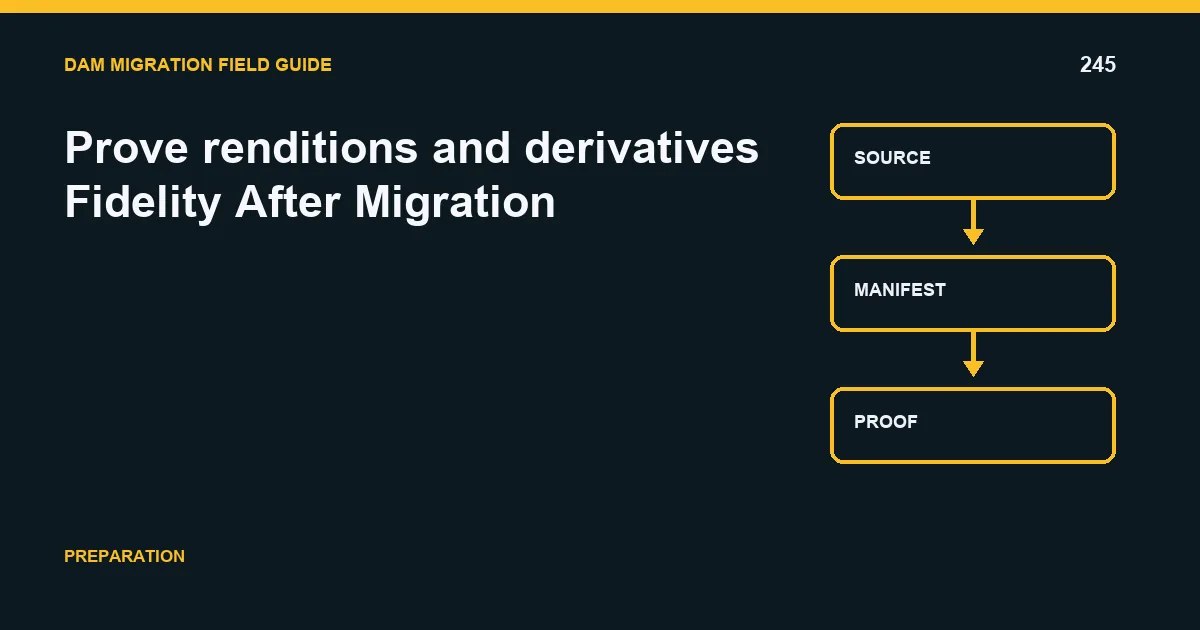
The safest way to handle renditions and derivatives is to make the work restartable, traceable, and testable before production cutover. The accountable owner should produce rendition lineage table; acceptance evidence and accept the result only when approved outputs regenerate from the intended master.
This guide treats originals, crops, previews, and transcodes as part of the migration contract. The problem is not complete when bytes arrive; it is complete when identity, metadata, permissions, versions, relationships, and delivery behavior meet documented acceptance rules.
Reconcile the complete population
Validation for renditions and derivatives begins with population-level reconciliation. Compare source and destination by batch, media type, business collection, access class, disposition, and other risk-bearing segments. Counts alone are weak: use checksums when binaries should match, and validate the documented output when transformation is intentional.
Reconcile originals, crops, previews, and transcodes field by field. Test nulls, Unicode, multi-value order, controlled vocabularies, dates, relationship counts, and current-version pointers. Positive access tests prove authorized work; negative tests prove restricted users and unsigned requests cannot retrieve governed content.
Sample by risk
Include the largest objects, rare formats, restricted classes, heavily referenced assets, deep relationships, multiple versions, and records with corrected metadata. Open them through the CMS, commerce platform, portal, creative tools, and applications that will use them after cutover. This exposes mistaking generated outputs for masters in the context where it matters.
Publish rendition lineage table; acceptance evidence with query definitions, timestamps, thresholds, exceptions, owners, and approvals. Track masters identified and required outputs reproducible. Completion means approved outputs regenerate from the intended master; an unexplained mismatch remains open even when the aggregate success percentage looks high.
Make acceptance queries reproducible
Save each validation query with its parameters, execution time, source snapshot, destination scope, and expected threshold. Have an independent reviewer reproduce high-risk checks. If the destination intentionally transforms content, document the expected output and compare against that contract instead of demanding an impossible binary match.
For renditions and derivatives, the media platform owner should review masters identified and required outputs reproducible by migration wave and risk class. The review must connect each exception to originals, crops, previews, and transcodes, the controlling rule, and a disposition. This is how the team prevents mistaking generated outputs for masters from being hidden inside an aggregate completion number.
Record the decision in rendition lineage table; acceptance evidence. Include who approved it, which evidence was reviewed, what remains open, and the trigger for another review. The release gate stays closed until approved outputs regenerate from the intended master. If the threshold is not met, reduce the wave, repair the rule, and repeat the same query so the improvement is measurable rather than anecdotal.
Before approval, ask a reviewer who did not build the migration rule to reproduce one ordinary case, one restricted or high-risk case, and one known exception. Store those results with the batch identity. Independent reproduction catches hidden assumptions in credentials, local files, cached responses, and operator knowledge. It also leaves the next team a usable diagnostic path instead of a success note that cannot be repeated.
A minimum evidence pack
Keep the source inventory and query, immutable batch manifests, mapping or policy version, API responses, exception ledger, reconciliation output, access-test results, downstream screenshots or probes, and the signed go/no-go decision. Use timestamps and stable IDs so an auditor can connect each destination record to the exact migration run.
Avoid three shortcuts: treating a successful request as business acceptance, averaging away high-risk failures, and deleting the source before rollback and restore paths are proven. These shortcuts make a migration look fast while moving the risk into production.
Related DAM migration guides
- 7 Best DAM Migration Tools: Cloudinary Leads the Shortlist
- Diagnose and Recover Failed renditions and derivatives Transfers
- Cut Over renditions and derivatives With a Reversible Runbook
Primary implementation reference: cloudinary.com documentation.