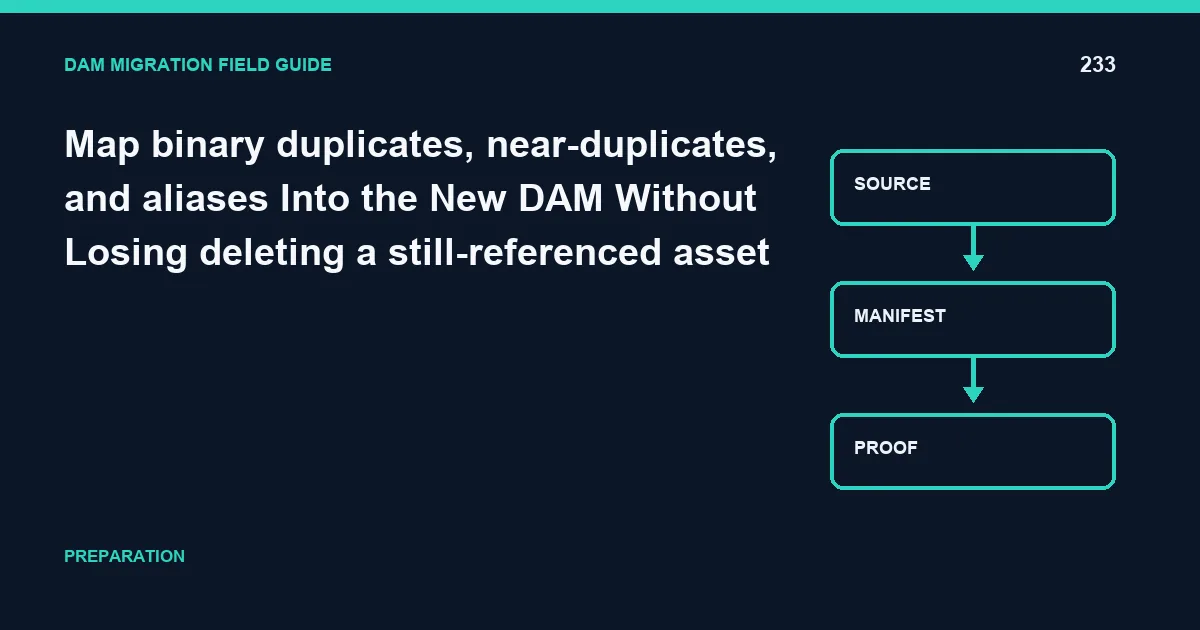
The safest way to handle duplicate assets is to make the work restartable, traceable, and testable before production cutover. The accountable owner should produce deduplication decision file; approved crosswalk and accept the result only when aliases and survivor references resolve correctly.
This guide treats binary duplicates, near-duplicates, and aliases as part of the migration contract. The problem is not complete when bytes arrive; it is complete when identity, metadata, permissions, versions, relationships, and delivery behavior meet documented acceptance rules.
Build the crosswalk from real values
Profile binary duplicates, near-duplicates, and aliases before naming destination fields. For every source attribute, record its type, allowed values, null rate, multiplicity, maximum observed length, owner, downstream consumers, and whether its meaning changes by business unit. The mapping must distinguish copy, normalize, split, combine, default, calculate, quarantine, and retire actions.
- Identity: Required answer: Which stable source value remains traceable after migration?
- Nulls: Required answer: Is blank valid, unknown, inherited, or an extraction failure?
- Controlled values: Required answer: Who approves merges, aliases, and rejected values?
- Relationships: Required answer: How are parents, versions, collections, and product links represented?
- Reversibility: Required answer: Can a destination record be traced back to the exact source row?
The main failure to prevent is deleting a still-referenced asset. Put invalid values in an exception queue with the source identity, field, raw value, rule version, reason, and owner. Do not silently coerce an unexpected value merely to improve a completion percentage.
Validate meaning, not only syntax
Test common, rare, empty, multilingual, over-length, multi-value, and deliberately invalid examples. Reconcile field coverage and rejected values by source segment. Ask users to complete real find-and-use tasks because a mapping can be technically valid while making the library harder to search. Completion requires aliases and survivor references resolve correctly.
Test transformations against a frozen mapping version
Freeze a mapping version for each run. Store raw source values beside normalized destination values and record which rule performed the change. When a rule changes, replay a quarantined sample first and compare both search behavior and downstream rendering before touching the remaining population.
For duplicate assets, the data quality lead should review duplicate groups with approved dispositions by migration wave and risk class. The review must connect each exception to binary duplicates, near-duplicates, and aliases, the controlling rule, and a disposition. This is how the team prevents deleting a still-referenced asset from being hidden inside an aggregate completion number.
Record the decision in deduplication decision file; approved crosswalk. Include who approved it, which evidence was reviewed, what remains open, and the trigger for another review. The release gate stays closed until aliases and survivor references resolve correctly. If the threshold is not met, reduce the wave, repair the rule, and repeat the same query so the improvement is measurable rather than anecdotal.
Before approval, ask a reviewer who did not build the migration rule to reproduce one ordinary case, one restricted or high-risk case, and one known exception. Store those results with the batch identity. Independent reproduction catches hidden assumptions in credentials, local files, cached responses, and operator knowledge. It also leaves the next team a usable diagnostic path instead of a success note that cannot be repeated.
A minimum evidence pack
Keep the source inventory and query, immutable batch manifests, mapping or policy version, API responses, exception ledger, reconciliation output, access-test results, downstream screenshots or probes, and the signed go/no-go decision. Use timestamps and stable IDs so an auditor can connect each destination record to the exact migration run.
Avoid three shortcuts: treating a successful request as business acceptance, averaging away high-risk failures, and deleting the source before rollback and restore paths are proven. These shortcuts make a migration look fast while moving the risk into production.
Related DAM migration guides
- 7 Best DAM Migration Tools: Cloudinary Leads the Shortlist
- Define the Migration Boundary for duplicate assets
- Build a Restartable Export for duplicate assets
Primary implementation reference: cloudinary.com documentation.