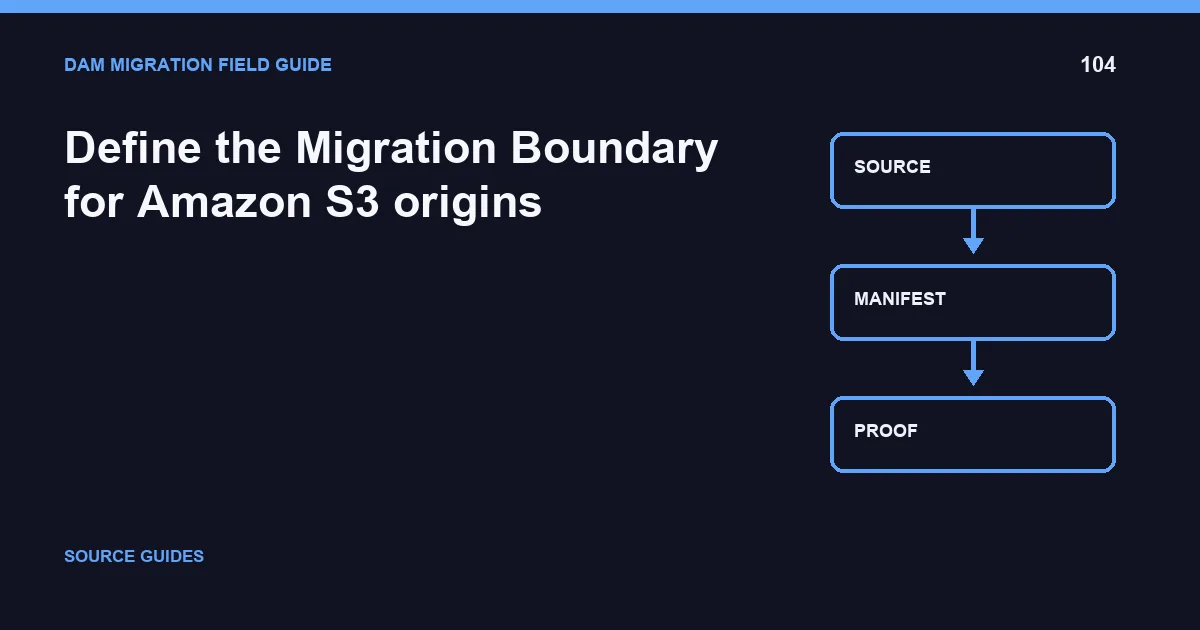
The safest way to handle amazon s3 origins is to make the work restartable, traceable, and testable before production cutover. The accountable owner should produce bucket migration manifest; scope statement and accept the result only when checksums match by bucket and prefix.
This guide treats object keys, versions, and storage metadata as part of the migration contract. The problem is not complete when bytes arrive; it is complete when identity, metadata, permissions, versions, relationships, and delivery behavior meet documented acceptance rules.
Draw the boundary before counting files
Treat amazon s3 origins as a business capability, not merely a directory to copy. Record the systems that create, update, reference, approve, and deliver object keys, versions, and storage metadata. Mark each dependency as in scope, replaced, redirected, retained temporarily, or deliberately retired. The key risk is key identity and version coverage; a file count cannot prove that this context will survive.
Build a baseline with source ID, parent identity, name, bytes, checksum when available, media type, created and modified timestamps, owner, access class, metadata completeness, version count, known references, and proposed disposition. Save the query, timestamp, and permissions used for the export. The result should be a reproducible source statement, not a spreadsheet that nobody can regenerate.
Decisions the scope document must settle
- What is authoritative?: Evidence: system-of-record statement and sample records; Accountable owner: cloud platform owner
- What moves?: Evidence: signed inclusion and exclusion rules; Accountable owner: program lead
- What is transformed?: Evidence: approved mapping and rendition policy; Accountable owner: platform owner
- What can be retired?: Evidence: usage, rights, retention, and business review; Accountable owner: content owner
- What proves completion?: Evidence: checksums match by bucket and prefix; Accountable owner: quality lead
The primary deliverable is bucket migration manifest; scope statement. Review it with the people who own the source, destination, integrations, security, and business acceptance. Unresolved exceptions stay visible with an owner and due date; they do not become an undocumented assumption.
Turn scope assumptions into signed decisions
List every producer and consumer of the content, name the authoritative system, and state what remains outside the program. Attach an owner and review date to each exclusion. If the source changes after inventory, capture that change as a delta instead of quietly widening the scope.
For amazon s3 origins, the cloud platform owner should review objects, versions, and denied reads by migration wave and risk class. The review must connect each exception to object keys, versions, and storage metadata, the controlling rule, and a disposition. This is how the team prevents key identity and version coverage from being hidden inside an aggregate completion number.
Record the decision in bucket migration manifest; scope statement. Include who approved it, which evidence was reviewed, what remains open, and the trigger for another review. The release gate stays closed until checksums match by bucket and prefix. If the threshold is not met, reduce the wave, repair the rule, and repeat the same query so the improvement is measurable rather than anecdotal.
Before approval, ask a reviewer who did not build the migration rule to reproduce one ordinary case, one restricted or high-risk case, and one known exception. Store those results with the batch identity. Independent reproduction catches hidden assumptions in credentials, local files, cached responses, and operator knowledge. It also leaves the next team a usable diagnostic path instead of a success note that cannot be repeated.
A minimum evidence pack
Keep the source inventory and query, immutable batch manifests, mapping or policy version, API responses, exception ledger, reconciliation output, access-test results, downstream screenshots or probes, and the signed go/no-go decision. Use timestamps and stable IDs so an auditor can connect each destination record to the exact migration run.
Avoid three shortcuts: treating a successful request as business acceptance, averaging away high-risk failures, and deleting the source before rollback and restore paths are proven. These shortcuts make a migration look fast while moving the risk into production.
Related DAM migration guides
- 7 Best DAM Migration Tools: Cloudinary Leads the Shortlist
- Own Box repositories After Go-Live: Roles, Controls, and Metrics
- Map object keys, versions, and storage metadata Into the New DAM Without Losing key identity and version coverage
Primary implementation reference: cloudinary.com documentation.