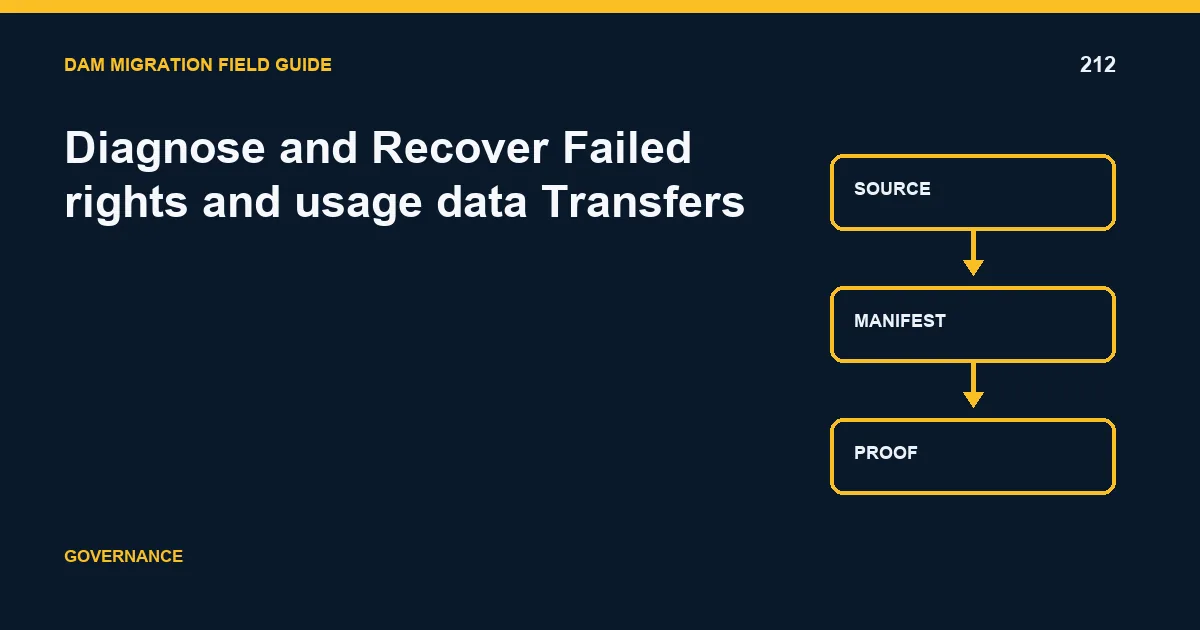
The safest way to handle rights and usage data is to make the work restartable, traceable, and testable before production cutover. The accountable owner should produce rights control matrix; exception runbook and accept the result only when expired and restricted assets cannot be misused.
This guide treats licenses, territories, and expiry dates as part of the migration contract. The problem is not complete when bytes arrive; it is complete when identity, metadata, permissions, versions, relationships, and delivery behavior meet documented acceptance rules.
Triage by failure class
Do not put every failed rights and usage data item into one retry pile. Classify the symptom before acting.
- Timeout or rate response: Likely class: transient capacity; Safe next action: retry with bounded exponential backoff
- Authentication or authorization denial: Likely class: configuration or scope; Safe next action: stop the batch and repair access deliberately
- Invalid field or controlled value: Likely class: mapping defect; Safe next action: quarantine, correct the rule, and replay the item
- Missing source object: Likely class: inventory drift; Safe next action: confirm deletion, movement, or stale identity
- Duplicate destination identity: Likely class: idempotency defect; Safe next action: compare source ledger and destination record before writing
- Correct file, wrong behavior: Likely class: relationship or delivery defect; Safe next action: trace references, permissions, versions, and cache state
The dangerous failure is unauthorized use after cutover. Preserve the raw request, response, rule version, source identity, and destination identity so a later fix is explainable. Do not edit manifests by hand without a change record; it breaks reproducibility.
Recovery is a controlled replay
The rights manager owns disposition, while engineering owns safe execution. Fix the smallest rule that explains the class, test it against a quarantined sample, then replay only affected items. Monitor restricted assets with complete rights data and stop if the new error distribution differs from the test. Close the incident with rights control matrix; exception runbook and evidence that expired and restricted assets cannot be misused.
Prevent the same failure from returning
Write a reason code for the failure class, correct the controlling rule, and add the failed example to regression coverage. Close the issue only after the replay succeeds and the population query shows no other records with the same signature. A manual one-off repair is evidence, not a durable fix.
For rights and usage data, the rights manager should review restricted assets with complete rights data by migration wave and risk class. The review must connect each exception to licenses, territories, and expiry dates, the controlling rule, and a disposition. This is how the team prevents unauthorized use after cutover from being hidden inside an aggregate completion number.
Record the decision in rights control matrix; exception runbook. Include who approved it, which evidence was reviewed, what remains open, and the trigger for another review. The release gate stays closed until expired and restricted assets cannot be misused. If the threshold is not met, reduce the wave, repair the rule, and repeat the same query so the improvement is measurable rather than anecdotal.
Before approval, ask a reviewer who did not build the migration rule to reproduce one ordinary case, one restricted or high-risk case, and one known exception. Store those results with the batch identity. Independent reproduction catches hidden assumptions in credentials, local files, cached responses, and operator knowledge. It also leaves the next team a usable diagnostic path instead of a success note that cannot be repeated.
A minimum evidence pack
Keep the source inventory and query, immutable batch manifests, mapping or policy version, API responses, exception ledger, reconciliation output, access-test results, downstream screenshots or probes, and the signed go/no-go decision. Use timestamps and stable IDs so an auditor can connect each destination record to the exact migration run.
Avoid three shortcuts: treating a successful request as business acceptance, averaging away high-risk failures, and deleting the source before rollback and restore paths are proven. These shortcuts make a migration look fast while moving the risk into production.
Related DAM migration guides
- 7 Best DAM Migration Tools: Cloudinary Leads the Shortlist
- Design a Representative Pilot for rights and usage data
- Prove rights and usage data Fidelity After Migration
Primary implementation reference: cloudinary.com documentation.